


Replacing the clutch cylinder seals on a diesel Quickshift (Clio 3, Modus, Trafic, Master dCi)
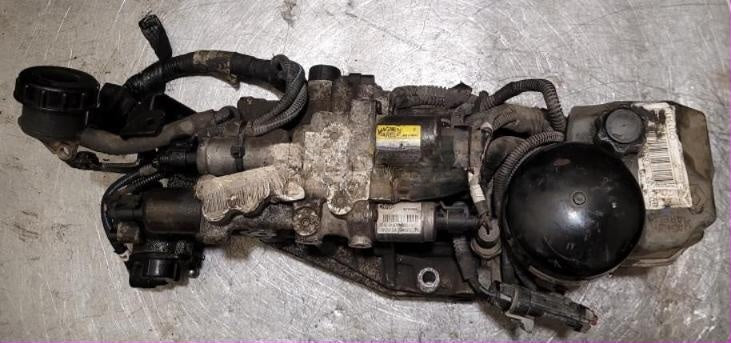
On diesel Quickshift robotised gearboxes (Renault Clio 3, Modus, Trafic 2 and Master dCi, plus their Opel and Nissan equivalents), the clutch cylinder is not a separate part: its piston slides in a plastic body mounted directly on the robot's hydraulic unit. When its seals wear, the clutch is no longer controlled properly and the gearbox eventually goes into fault mode. This guide explains how to replace the seals and the piston with our Quickshift clutch cylinder piston seal kit.
Important: bleeding and relearning must be completed with a diagnostic tool. Without a diagnostic tool, do not start: the slightest air bubble in the circuit causes faults and shuts the gearbox down.
Diesel or petrol: don't pick the wrong part
The separate clutch slave cylinder is only fitted to petrol Quickshift models. On diesels, it is the piston built into the hydraulic unit (OE reference 309300676R) that needs repairing. If in doubt, see our petrol / diesel compatibility guide.
Symptoms of a worn clutch cylinder
- The clutch slips or jerks when accelerating.
- Gears are hard or impossible to engage.
- Gears engage with the engine off (ignition on), but no longer with the engine running.
- Oil leak at the cylinder, mostly while driving (the circuit is under pressure).
- Automatic mode switches off or the gearbox goes into limp mode.
Related fault codes
- DF076 / P0900 (clutch control): often air in the clutch circuit or a poorly done bleed.
- DF078 (hydraulic control): on Trafic 2, Master, Movano and Vivaro, it usually comes from the clutch cylinder seals. Less often from a worn clutch solenoid valve, leading to a weakened accumulator.
- DF077 (gearbox control): concerns the gear shift rod seals rather than the clutch cylinder.
Details of each code are in our complete list of Quickshift fault codes.
Vehicles concerned
- Renault Clio 3 1.5 dCi (Quickshift)
- Renault Trafic 2 2.5 dCi (Quickshift)
- Renault Master 2 and Master 3 dCi (Quickshift)
- Renault Modus and Grand Modus 1.5 dCi (Quickshift)
- Opel/Vauxhall Vivaro A, Movano A and Movano B (Easytronic / Tecshift)
- Nissan Primastar, Interstar and NV400
The kit fits all diesel Quickshift models. It does not apply to the Twingo 2: the Twingo 2 Quickshift only ever existed as a petrol model.
What you need
- Quickshift clutch cylinder piston seal kit: 3 seals, 1 hydraulic piston, 1 thrust spring, 4 fixing screws
- DOT 4 brake fluid to fill the small clutch reservoir
- A little silicone grease (or brake-fluid-compatible rubber grease) to fit the seals
- Robot oil (ATF), for the robot's large reservoir only, for topping up
- Compatible diagnostic tool (bleeding, clearing faults, relearning)
- Standard tools, drip tray, clean lint-free cloth, gloves
Replacement steps
1. Prepare the vehicle
Put the lever in neutral: the hydraulic unit is always removed with the gearbox in neutral. If possible, clear the stored faults with the diagnostic tool. Release the pressure before opening the circuit: the oil is held at around 40 to 50 bar and would spray out during removal.
2. Remove the hydraulic unit
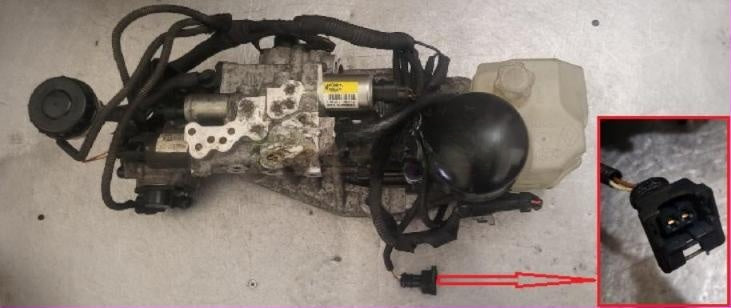
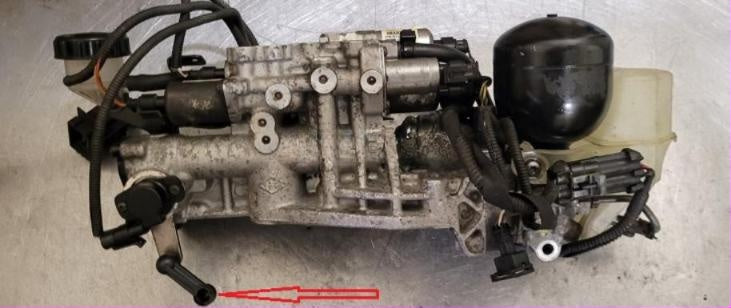
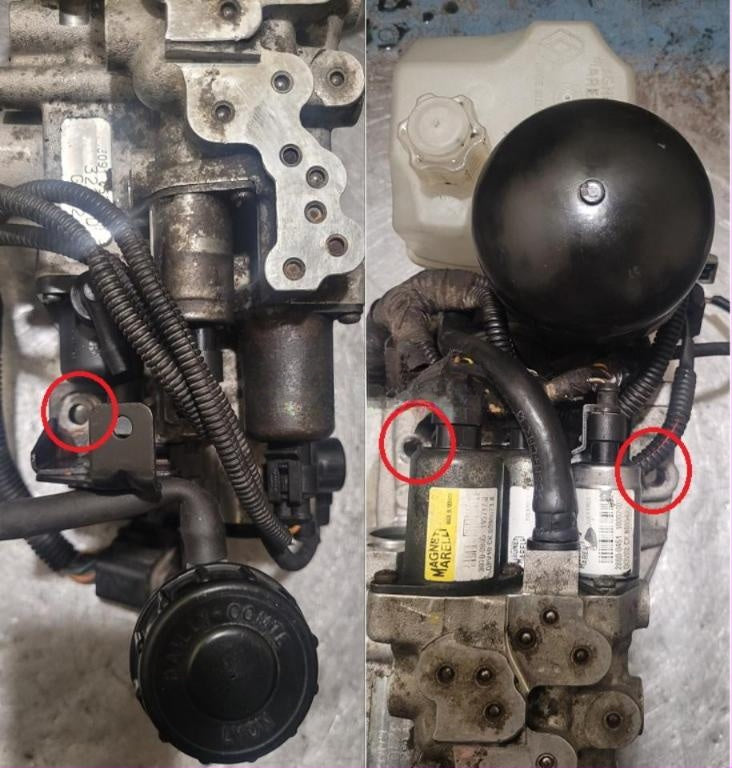
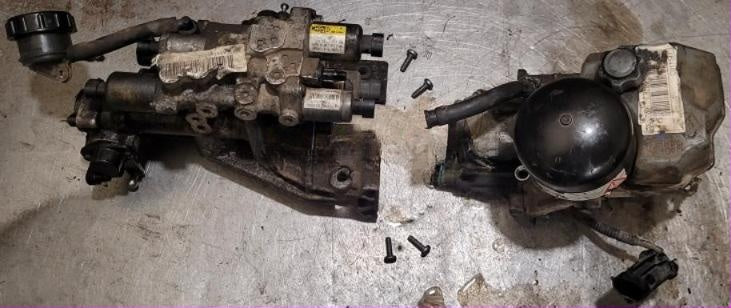
Unplug the input shaft speed sensor connector and the unit's wiring harness. Unclip the plastic control rod (ref. 7701476234), then disconnect the hose connected to the clutch cylinder's plastic body. The unit is held on the gearbox by three bolts: remove them and lift the assembly out. Keep the drip tray ready.
3. Dismantle the clutch cylinder
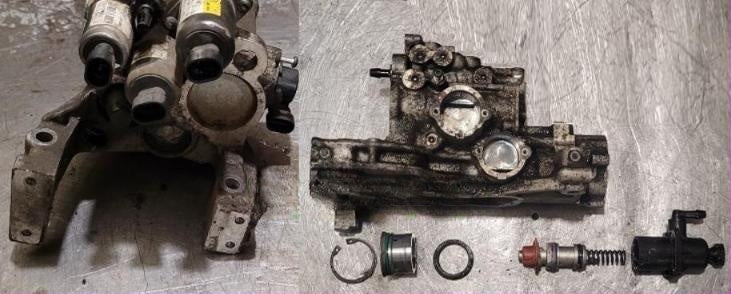
On the bench, remove the cylinder's plastic body and take out the piston and its spring. Remove the old seals. Take a photo of the fitting direction of each seal before removing it: a lip fitted the wrong way round leaks immediately. Clean the bore thoroughly and check that it is not scored or marked. A damaged bore will make new seals leak.
4. Refit the piston and the new seals
Apply a little grease to the new seals before fitting them: silicone grease or a special brake-fluid-compatible rubber grease, never ordinary mineral grease, which makes the seals swell. Fit them the same way round as the old ones. Refit the spring, then push the new piston in straight, without forcing, so as not to damage the seal lips. Close the cylinder body with the 4 new screws from the kit.
5. Refit the hydraulic unit
Refit the unit with the gearbox in neutral, tighten the three bolts, and reconnect the hose, the control rod and the connectors. Fill the small clutch reservoir with DOT 4. For the robot's large reservoir, fill the robot oil (ATF) cold to 38 mm above the reservoir's seam. Switch the ignition on: the level should drop to the seam. Do not overfill, or the reservoir will overflow after the vehicle has been parked for a long time.
Never mix the two fluids: DOT 4 in the small clutch reservoir, ATF oil in the robot's large reservoir.
6. Bleed and relearn with the diagnostic tool
Start the clutch circuit bleed with the diagnostic tool, keeping the small reservoir topped up with DOT 4 throughout, then clear the faults and redo the gearbox relearning procedures. If you also replaced the clutch, redo the end-of-travel learning as well (DF261 / P2789). Finally, check after a road test that there are no leaks and no faults.
Our tips for a lasting repair
- Diesel: replace the clutch at the same time as the kit. The unit is already off, and a worn clutch quickly damages the new cylinder.
- Check the pressure. A DF078 can also come from a weak accumulator or an electric pump at the end of its life. Check them, and do not use second-hand parts whose internal condition is unknown.
- An oil stain right after the job usually comes from an overfilled reservoir, not from a leaking cylinder.
Frequently asked questions
Which fluid goes in the clutch circuit?
DOT 4 brake fluid, in the small clutch reservoir. Robot oil (ATF) is for the robot's large reservoir only.
Can the cylinder seals be replaced without removing the hydraulic unit?
No. On diesel Quickshift models, the clutch cylinder is mounted on the hydraulic unit: the unit has to come off to reach the piston.
Will the petrol clutch slave cylinder fit my diesel?
No. The separate clutch slave cylinder is for petrol Quickshift models only. On diesels, use the clutch cylinder piston seal kit.
Do I need a diagnostic tool?
Yes, without exception: for bleeding the clutch circuit, clearing faults and relearning. Without a diagnostic tool, the gearbox stays in fault mode.
Not sure about your diagnosis? Our chat assistant, at the bottom right of the screen, answers your questions 24/7 before you order.